
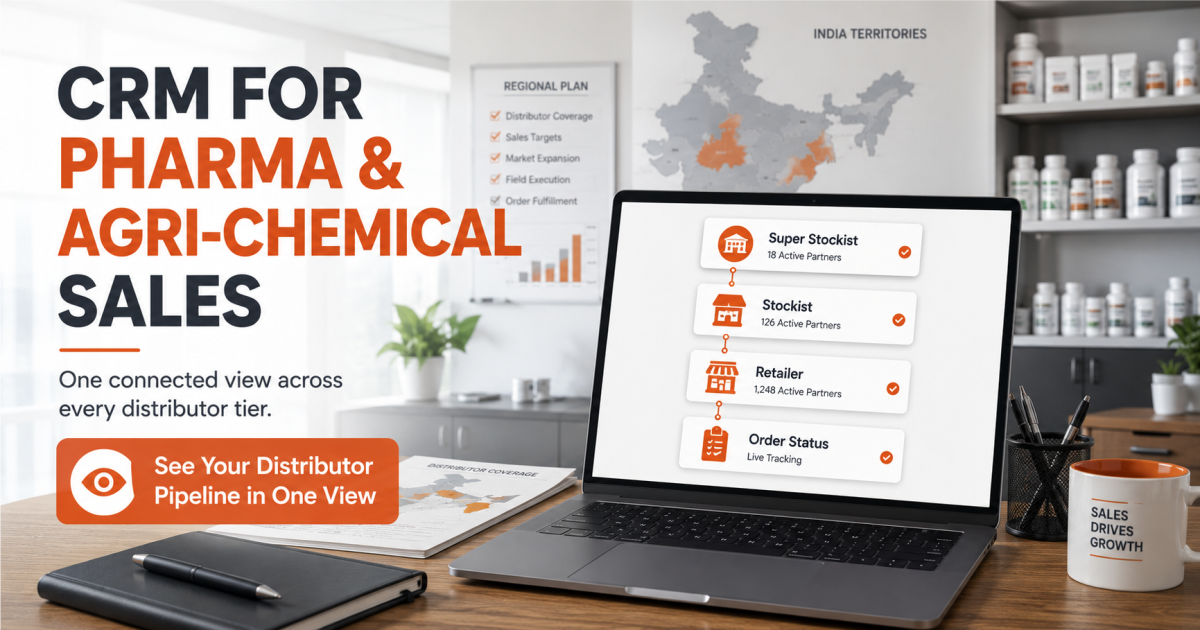
One person at a pharma or agri-chemical distributor knows which stockist ordered what last month, which field rep visited which retailer last week, and which quotation is still pending approval. Usually it’s the Sales Head, and usually that knowledge lives in three places at once — a distributor Excel sheet, a WhatsApp group with forty field reps in it, and their own memory. When that person is travelling, on leave, or simply buried under month-end order chasing, distributor follow-ups slip, field visits go unrecorded, and management finds out about a lost account after the fact, not before.
A generic CRM for pharma companies India buyers try first — the kind built for SaaS sales teams or generic B2B lead tracking — doesn’t map to any of this. It has no concept of a distributor tier, a field rep beat plan, or a sample dispatch tied to a trial outcome. Pharma and agri-chemical sales don’t run on a single pipeline. They run on layered distributor networks, on-the-ground field visits, and quotations that vary by region and product batch.
Quick Answer
A CRM for pharma companies India and agri-chemical businesses need must handle three things a generic CRM does not: multi-tier distributor management (super stockist, stockist, retailer), field force activity tracking that shows visits and follow-ups as they happen — not at month-end — and a quotation workflow that accounts for regional pricing and sample-to-order conversion. For pharma distribution and agri-chemical businesses tracking this in Excel and WhatsApp today, this is where orders get missed and field visibility disappears the moment a rep leaves the office. A CRM built around the distributor and field-rep reality closes that gap before it reaches the Sales Head’s desk.
The Reality of Pharma and Agri-Chemical Sales in India
This is not generic B2B selling. Pharma distribution and agri-chemical sales in India run through structured layers — a company sells to a super stockist, the super stockist sells to stockists across a region, and stockists sell to hundreds of retailers or dealers on the ground. Field representatives visit these retailers directly, take orders, resolve stock issues, and report back — usually by phone call or WhatsApp message at the end of the day. Order tracking has to hold up across regions with different pricing, different compliance documentation, and different distributor relationships. None of this is generic, and none of it fits into a CRM built for a single-tier B2B sales team.
1. The Distributor Management Problem
Distributor networks in this vertical are large and layered, and most companies manage them the same way regardless of size.
- Multiple distributor tiers with no single view. Super stockist, stockist, and retailer sit in separate Excel tabs, sometimes maintained by separate people. No one sees the full chain for a single order.
- Order follow-up across hundreds of contacts. A regional sales team may be chasing 200–400 distributor and retailer contacts for orders, payments, and stock status — tracked manually, one WhatsApp thread at a time.
- No visibility into distributor performance. Which distributor is under-ordering this quarter? Which one hasn’t been contacted in three weeks? Without a structured view, this question takes a day of Excel work to answer, if it gets answered at all.
- Payment and order status live in different systems. Orders are noted in one place, payments tracked in the ERP, and no one connects the two without manually cross-checking.
This is not a question of discipline. It is a question of structure.
Still chasing distributor orders across Excel tabs?
See what a single distributor pipeline view looks like for pharma and agri-chemical sales teams.
Get a 15-Day Pilot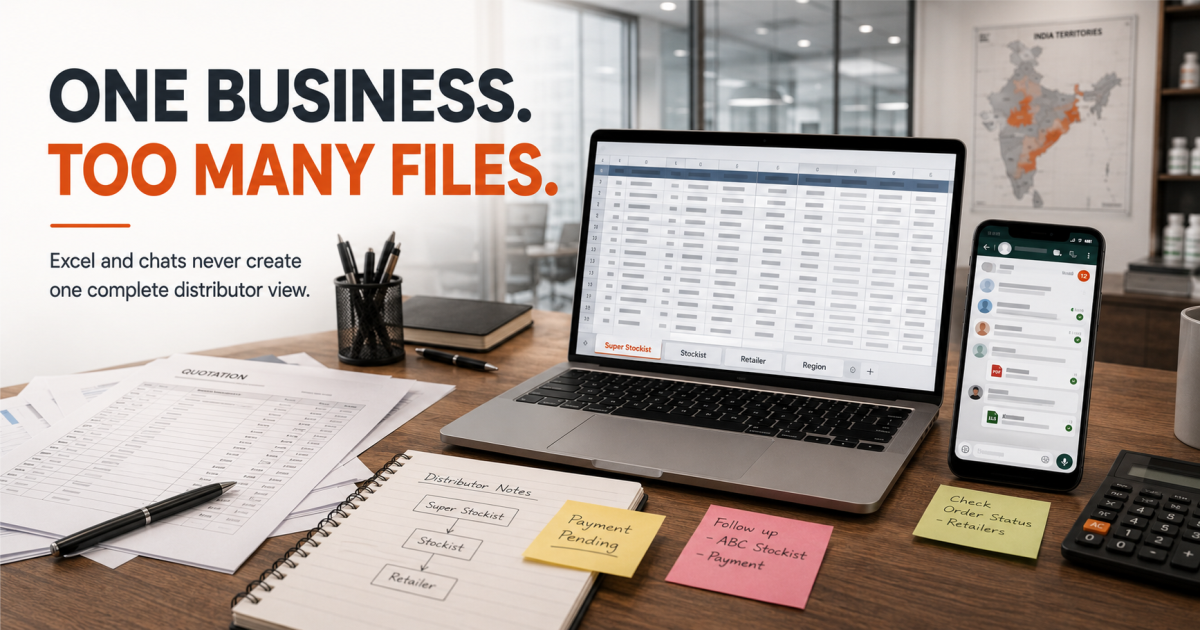
2. Field Force Visibility — The Month-End Surprise
Field representatives are the company’s eyes on the ground, visiting retailers, resolving complaints, and generating orders across a region. But most companies only see this activity in a report submitted at the end of the month — a summary written from memory, days or weeks after the visits happened.
By the time that report reaches the Sales Head, the information is already stale. A retailer complaint that needed a same-day response gets addressed a week late. A competitor’s aggressive push into a territory goes unnoticed until a distributor’s order volume has already dropped. The system owns the reminder, not a person — and right now, for most pharma and agri-chemical sales teams, no system owns it at all.
3. Quotation and Order Workflow
Quotations in this vertical carry more variation than a standard B2B sales quote:
- Sample requests precede most orders. A distributor or large retailer wants a product sample before committing to a bulk order — and that sample request needs to be logged, tracked, and linked back to the eventual order.
- Approval layers slow things down. Quotations often need Sales Head or regional manager sign-off before they go out, especially for larger volumes or new distributor relationships.
- Pricing varies by region and distributor tier. A super stockist price is different from a retailer price, and both can shift by state depending on local market conditions and competition.
- Version control breaks down in Word and Excel. Multiple quotation versions circulate over email with no clear record of which one the distributor actually agreed to.
4. What TargetCRM Handles in This Vertical
TargetCRM is built around the actual workflow — not a generic sales pipeline retrofitted for pharma and agri-chemical use.
- Lead-to-quotation tracking, including sample requests and approval stages before a quotation is finalized.
- Field rep activity tracking — visits, orders, and follow-ups logged from a mobile device as they happen, not reconstructed at month-end.
- Distributor pipeline visibility across super stockist, stockist, and retailer tiers, so a Sales Head can see the full chain for any account without switching between spreadsheets.
- Management dashboard showing order status, distributor performance, and field activity by region, updated in real time rather than compiled manually.
For a Sales Head managing distributor follow-ups in Excel and WhatsApp today, this is the shift: from chasing information after the fact to seeing it as it happens. See how it works on the TargetCRM product page.
5. What TargetCRM Does Not Do
Honesty matters more than a feature list here. TargetCRM is a CRM — it is not a regulatory compliance system, a batch tracking tool, or a quality management system. It does not generate the documentation pharma companies need for regulatory audits, and it does not track product batches through manufacturing and distribution for compliance purposes.
Where a pharma or agri-chemical business needs QMS integration or batch-level compliance tracking, TargetCRM is set up to integrate with existing systems handling that function — the CRM manages the sales and distributor relationship, and connects to the systems that manage compliance, rather than replacing them. That scope conversation happens during implementation, not after go-live. For more on what generic spreadsheets miss versus a structured system, see Excel vs CRM: What Actually Breaks First, and for adjacent manufacturing workflow patterns, see how manufacturing teams structure CRM workflows.
See how TargetCRM handles distributor and field force tracking
Built specifically for multi-tier distributor networks and on-ground field teams — not retrofitted from a generic sales pipeline.
Book a DemoThe Real Shift
Right now, distributor follow-up depends on who remembers to send the next WhatsApp message. Field visibility depends on a report written days after the fact. This works until it doesn’t — until a distributor churns quietly, or a field rep leaves and takes six months of relationship history with them. A structured CRM doesn’t remove the relationship work pharma and agri-chemical sales depend on. It makes sure that work doesn’t disappear the moment one person is unavailable. Learn more about the structure of distributor networks in B2B sales.
TargetCRM brings distributor and field force management into one system.
For pharma distribution and agri-chemical sales teams outgrowing Excel and WhatsApp.
Talk to Our TeamFrequently Asked Questions
Before you choose your CRMStart with your workflow, users and tools—not a generic feature checklist.
What CRM do pharma companies use in India?
Most pharma companies in India still manage sales on Excel and WhatsApp, with a smaller number using generic CRMs not built for distributor networks. A CRM suited to pharma distribution needs multi-tier distr-aibutor tracking, field rep activity logging, and a quotation workflow that handles sample requests and regional pricing — features generic CRMs do not offer out of the box.
How do agri-chemical companies manage distributors with CRM?
A CRM built for this vertical tracks distributors across tiers — super stockist, stockist, and retailer — in one system, giving management a single view of order status, payment status, and distributor performance by region, instead of separate Excel sheets per tier or per territory.
What is field force management in pharma?
Field force management means tracking where sales representatives go, who they visit, and what happens on each visit — orders taken, complaints resolved, samples delivered — as it happens, rather than compiling it from memory into an end-of-month report.
Does TargetCRM work for pharma distribution companies?
Yes. TargetCRM handles the workflows specific to pharma distribution — multi-tier distributor tracking, field rep activity logging, sample request and quotation approval, and management dashboards by region. It is not a regulatory compliance or QMS system, and integrates with those systems where a business needs them.
How does CRM help with compliance tracking in pharma?
A sales CRM like TargetCRM is not a compliance system on its own, but it gives a clean, structured sales and distributor record that can be referenced during audits, and it integrates with dedicated compliance or QMS tools where batch-level regulatory tracking is required.
What is the difference between CRM for pharma vs generic CRM?
A generic CRM tracks a single sales pipeline with one buyer per deal. A CRM for pharma and agri-chemical businesses needs to handle layered distributor networks, field rep visit tracking, sample-to-order workflows, and regional pricing variation — structures a generic CRM was not built around.