

The CRM rollout usually has one owner. Often it is the sales head, sometimes an operations manager who pushed for the purchase. Then quarter-end arrives, or a major customer escalation, and that person goes back to firefighting. The reps quietly return to Excel and WhatsApp. This is how most CRM implementation failure starts. Three months later, the CRM holds outdated leads, the MD has stopped opening the dashboard, and the renewal invoice looks like wasted money.
Quick Answer
CRM implementation failure means a business has bought and configured a CRM, but the team does not use it to run daily sales and service work. The real work still happens in spreadsheets, WhatsApp chats, and personal diaries. It is rarely a software problem. The rollout was designed around the system, not around how the team actually sells. For growing Indian B2B businesses, this is where follow-ups slip and quotations go cold. A rollout built around the team’s real workflow stops that before it reaches the MD’s desk.
What a failed CRM rollout actually looks like
Failure rarely shows up as a single dramatic moment. It shows up as small signals that nobody connects:
- Reps update the CRM on Friday evening, in bulk, from memory.
- The weekly sales review still runs from an Excel sheet someone prepares on Monday morning.
- Customer conversations happen on WhatsApp, and the CRM never sees them.
- Quotations are made in Word or Tally and attached later, if at all.
- When the MD asks “where is this deal?”, someone picks up the phone instead of opening the system.
None of this means the team is careless. Most sales teams in growing businesses are already working hard and closing deals with the tools they trust. They simply went back to what worked before.
The software did not fail. The rollout did.
Why CRM implementation failure is so common in Indian businesses
Customer relationship management as a practice is simple. The challenge is fitting a system into how Indian B2B teams actually work. These are the patterns that show up again and again:
- The CRM is set up for the MD’s reports, not the rep’s day. Fields, stages, and dashboards are designed for management visibility. The rep only sees extra data entry and gets nothing back, so they stop entering.
- WhatsApp and phone calls stay outside the system. In Indian B2B sales, much of the real conversation happens on WhatsApp and calls. If the CRM does not hold that context, it becomes a parallel system that is always out of date.
- The process is copied from software defaults, not mapped from reality. Your quotation approval, dealer handoffs, credit terms, and repeat-order cycles are specific to your business. Generic pipeline stages do not reflect them, and the team notices immediately.
- One person owns the rollout. When the champion is busy, on leave, or moves on, nobody else feels responsible. Adoption stalls quietly.
- Everything goes live at once. Leads, quotations, support tickets, and reports all switch over in week one. The team is overwhelmed, and the first bad week becomes the reason to give up.
- Old data is imported without cleaning. Duplicate contacts, dead leads, and wrong phone numbers from years of Excel land in the new system. Reps lose trust in the data within days.
- Training is a one-day event. A single session before go-live, then nothing. Questions that come up in week three have no one to answer them.
Adoption is not a training problem. It is a design problem.
Seeing these signs in your current CRM rollout?
Talk to our team about where your rollout is stalling and what to fix first.
Talk to our team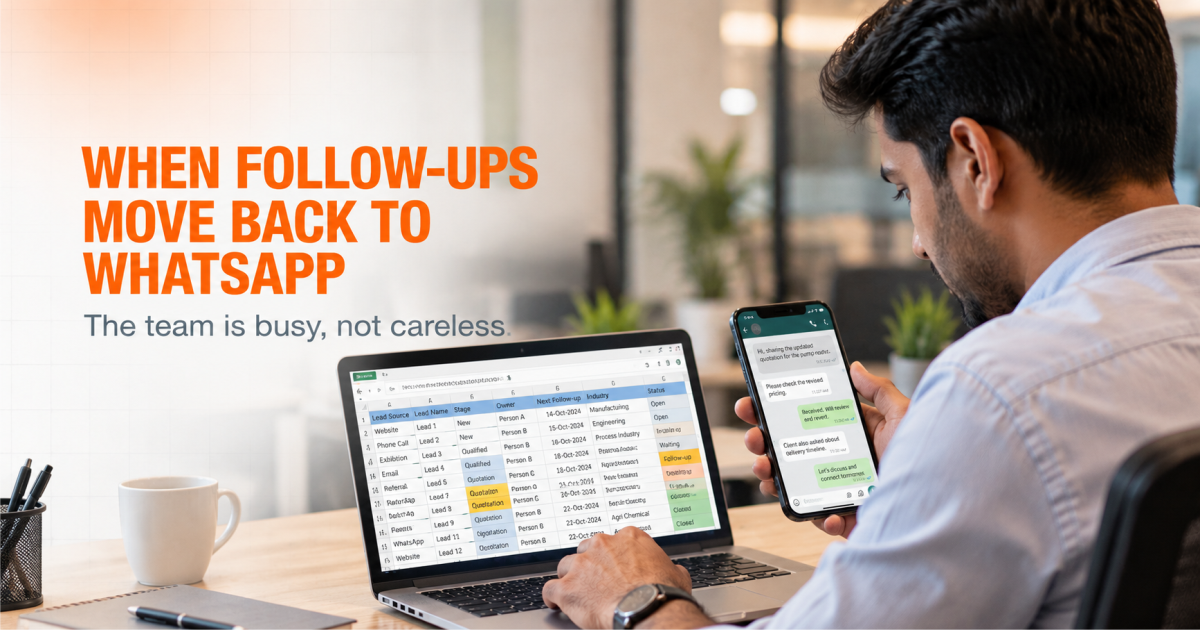
How to avoid CRM implementation failure: what to do differently
Most CRM implementation failure can be prevented at the planning stage, before a single field is configured. Here is what changes the outcome:
- Start with one workflow. For most sales teams, the right starting point is lead-to-quotation follow-up. Get that running daily before adding support, reports, or automation.
- Map your actual process first. Sit with two or three reps and write down how a lead really moves, including the WhatsApp messages, the approval calls, and the informal steps. Configure the CRM to match that, then improve it.
- Give reps something back from day one. A daily follow-up list, quotation reminders, or a clear view of pending payments makes the CRM useful to the person entering the data, not only to the person reviewing it.
- Run the review meeting from the CRM. When the MD’s weekly sales review uses the CRM screen instead of an Excel sheet, updating the CRM stops being optional. This single change does more for adoption than any training session.
- Assign ownership to a role, not a person. Make CRM hygiene part of a defined role, such as the sales coordinator, with a backup. The system should not depend on one person’s availability.
- Clean data before you migrate. Import only active customers and live opportunities. Archive the rest. A smaller, trusted database beats a large, doubtful one.
- Phase the rollout and plan for after go-live. Treat implementation as change management, not a software installation. Plan for support in the first 60–90 days, when real usage questions surface.
If there is one lesson that holds across years of CRM implementations for Indian businesses, it is this:
Adoption follows usefulness.
Teams use systems that make their own day easier.

See a phased rollout built around your workflow
Get a TargetCRM walkthrough mapped to your leads, follow-ups, and quotations, before you commit to anything.
Book a TargetCRM walkthroughHow TargetCRM approaches implementation
TargetCRM is built for growing businesses that have outgrown Excel and WhatsApp but do not need an enterprise system. It covers leads, follow-ups, quotations, sales pipelines, workflows, and customer support in one place.
The implementation approach matters as much as the product:
- We map your current sales workflow before configuring anything.
- We go live in phases, usually starting with lead and follow-up management.
- We set up dashboards so the MD’s review can run from the CRM from the first month.
- Our team stays involved after go-live to handle the questions that only real usage brings up.
To see how leads, follow-ups, and quotations are managed day to day, explore TargetCRM Sales CRM. For the dashboards that let the MD’s weekly review run from the CRM, see Analytics and Reporting.
A CRM your team actually uses starts with the rollout.
Tell us how your sales team works today, and we will show you where TargetCRM fits first.
Plan your CRM rolloutFrequently Asked Questions
Before you choose your CRMStart with your workflow, users and tools—not a generic feature checklist.
What is the most common cause of CRM implementation failure?
The most common cause is setting up the CRM around management reports instead of the sales team’s daily work. Reps see extra data entry and get nothing useful back, so they stop updating it. Within weeks the data is outdated, the MD stops trusting the dashboard, and the team returns to Excel and WhatsApp. The fix starts with giving reps a daily follow-up list from day one.
How long should a CRM implementation take for a growing business?
It depends on how many workflows you bring into the CRM at once. A phased rollout that starts with one workflow, usually lead and follow-up management, gets the team using the system sooner than a single full go-live. Once that workflow runs daily, quotations, support, and reports can be added in stages without overwhelming the team.
How do I get my sales team to actually use the CRM?
Make the CRM useful to reps before asking them to update it. Give them a daily follow-up list, quotation reminders, and a clear view of pending payments. Then run the weekly sales review from the CRM screen instead of an Excel sheet. When the review depends on the system, updating it stops being optional and becomes part of the routine.
Should we migrate all our old Excel data into the new CRM?
No. Migrate only active customers and live opportunities, after removing duplicates, dead leads, and wrong contact numbers. Archive the rest outside the new system. A smaller database the team trusts is far more useful than a large one full of doubtful records. Reps who find bad data in the first week often stop relying on the CRM altogether.
Can a CRM work if our sales team mostly uses WhatsApp?
Yes, but only if the context of those conversations is recorded against the lead or customer. In Indian B2B sales, many decisions happen on WhatsApp and phone calls. If those discussions stay outside the CRM, the system will always be incomplete, and the team will treat it as a parallel record rather than the place where deals are managed.
Is it better to implement a CRM in-house or with a partner?
A partner helps most with process mapping, data cleaning, phased go-live, and post-launch support, which are the stages where CRM implementation failure usually begins. An in-house rollout can work if you have a dedicated owner with real time to run it, plus a backup. Without that, the project tends to stall the first time the owner is pulled into urgent work