
Quick Answer
Sales cycle automation means the system — not a person’s memory — owns lead follow-up, reminders, and quotation tracking, so no opportunity waits on someone remembering to act. For growing B2B teams, this is where deals quietly stall: a lead goes cold not because the product was wrong, but because the next step never happened. Sales cycle automation inside a CRM closes that gap before a competitor closes the deal instead.
Where Deals Actually Stall (Not Where You Think)
One sales rep owns fifteen open leads at any given time. Some came from a call, some from a website form, some from a WhatsApp inquiry after an exhibition. Each one needs a follow-up on a specific day. When that rep gets pulled into a client visit, a proposal deadline, or simply a busy Tuesday, the follow-up slips from “tomorrow” to “next week” to never. By the time someone circles back, the buyer has already spoken to two other vendors.
This is not a question of discipline. It is a question of structure.
Most growing sales teams hit the same set of failure points once lead volume crosses a certain size:
- Leads sit unread in an inbox or a WhatsApp thread with no owner assigned and no follow-up date attached.
- Follow-ups happen on memory, not on a system-triggered reminder — so the busiest week is exactly when the most leads get dropped.
- Quotations go out with no tracking. No one knows if a quotation was opened, ignored, or lost to a competitor mid-cycle.
- Management has no visibility into where deals are stuck — discovery, quotation, negotiation — until a deal is already lost and someone asks why.
- Marketing and sales leads never connect. A social media inquiry and a call-in lead are tracked in two different places, if they are tracked at all.
Sales cycle automation exists to remove exactly these five gaps — not by replacing the sales team, but by making sure nothing depends on one person remembering one thing at the right moment.
What Sales Cycle Automation Actually Means for a Growing Sales Team
Sales cycle automation is often mistaken for a dashboard or a chatbot. In practice, for a growing B2B sales team, it means three specific things happening inside the CRM without manual effort:
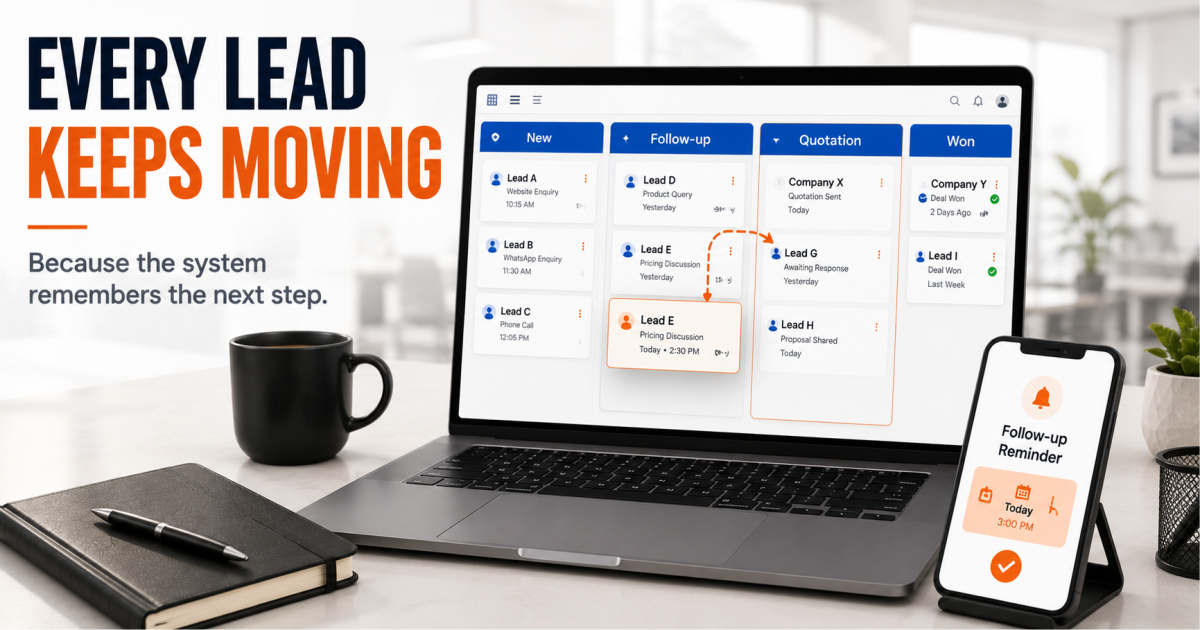
- Every new lead — from a call, WhatsApp, website, or exhibition — is captured with an owner and a next follow-up date assigned automatically.
- Every follow-up that is missed triggers a reminder to the rep and, after a set threshold, a visibility flag to the manager.
- Every quotation is logged with a status, so a stalled quotation shows up in a pipeline view instead of disappearing into an inbox.
The system owns the reminder, not a person. That single shift is usually what separates a sales team that recovers stalled deals from one that quietly loses them.
Is this happening in your sales team?
See how automated follow-ups and pipeline visibility work for teams your size.
See TargetCRM In Action
How TargetCRM Shortens Each Stage of the Cycle
Sales cycle automation inside TargetCRM works stage by stage, not as one generic “automation” feature layered on top:
- Lead capture to assignment — a lead from any source (call, WhatsApp, website form, exhibition list) is logged and assigned to a rep automatically, with the first follow-up date set at the point of entry.
- Follow-up to quotation — every follow-up interaction is logged against the lead, so the rep’s next action is always visible instead of remembered.
- Quotation to decision — quotations are tracked with status, so a rep or manager can see which quotations are open, stalled, or won without opening a separate Excel file.
- Decision to onboarding — once a deal closes, the same record carries forward, so the customer’s history does not start over with a new team or a new system.
This works until it doesn’t — and the “doesn’t” is almost always a manual step someone forgot, not a failure of the sales team’s effort. Sales cycle automation exists to remove that manual step from the equation entirely.
Most standard sales, follow-up, quotation, and reporting workflows can be set up in around 30 days when scope, users, and data are ready.
What Changes for Your Sales Team After Go-Live
The outcome is not a fancier dashboard. It is fewer leads going cold between the first call and the signed order. Reps spend less time chasing their own memory and more time on the conversations that actually move a deal forward. Management gets a pipeline view instead of chasing five people for five different numbers on a Friday afternoon.
None of this depends on adding headcount. It depends on making sure the system — not any one person’s calendar — owns the follow-up.

Talk to us about your current lead-to-close workflow.
We’ll show you exactly where a stalled deal is likely hiding in your pipeline today.
The Real Cost of Skipping Sales Cycle Automation
Every growing sales team eventually crosses a point where memory-based follow-up cannot keep pace with lead volume. The teams that stay on Excel and WhatsApp past that point do not lose deals dramatically — they lose them quietly, one missed follow-up at a time, until a quarter’s numbers do not add up and no one can say exactly why.
Sales cycle automation is not about replacing your sales team’s judgment. It is about making sure their judgment gets applied to every lead, not just the ones someone happened to remember.
TargetCRM is built for exactly this gap.
Every lead has an owner. Every follow-up has a date. Nothing depends on memory.
FREQUENTLY ASKED QUESTIONS
What is sales cycle automation in a CRM?
Sales cycle automation means lead assignment, follow-up reminders, and quotation tracking happen inside the system automatically, instead of depending on a sales rep remembering each step. It reduces the number of leads that go cold simply because no one followed up in time.
How does sales automation actually shorten the sales cycle
It removes the delay between “this needs a follow-up” and “someone acts on it.” Reminders trigger automatically, quotations show a live status, and managers can see stalled deals before they are lost — cutting the dead time between contact and decision.
Can sales cycle automation work for a small sales team?
Yes. Teams as small as five to ten users benefit because the same person is often juggling calls, WhatsApp leads, and quotations. Automation removes the memory dependency regardless of team size.
Does sales automation replace the sales team?
No. It removes manual tracking work — logging follow-ups, chasing quotation status, updating spreadsheets — so reps spend that time on actual conversations with buyers instead.
How long does it take to set up sales cycle automation in TargetCRM?
For standard lead, follow-up, quotation, and reporting workflows, TargetCRM can be set up in around 30 days when scope, users, and data are ready.
What happens to leads that come in from different sources — WhatsApp, calls, website?
They are captured into the same pipeline with an owner and follow-up date assigned automatically, regardless of source, so nothing sits in a separate inbox or personal notebook.
Does this require sales reps to change how they work?
Reps still make the calls and have the conversations. What changes is that the system tracks what needs to happen next, instead of the rep having to remember it across fifteen open deals.
Start with one real example
Show us where customer work gets stuck.
A missed follow-up. A sales-to-delivery handover. A service escalation. Bring the process you want to improve.
Email connect@targetcrm.cloud with your workflow and user count.

Connect with us today
Let’s discuss your next project—connect with our team today for tailored solutions.
Schedule a calltargetcrm